
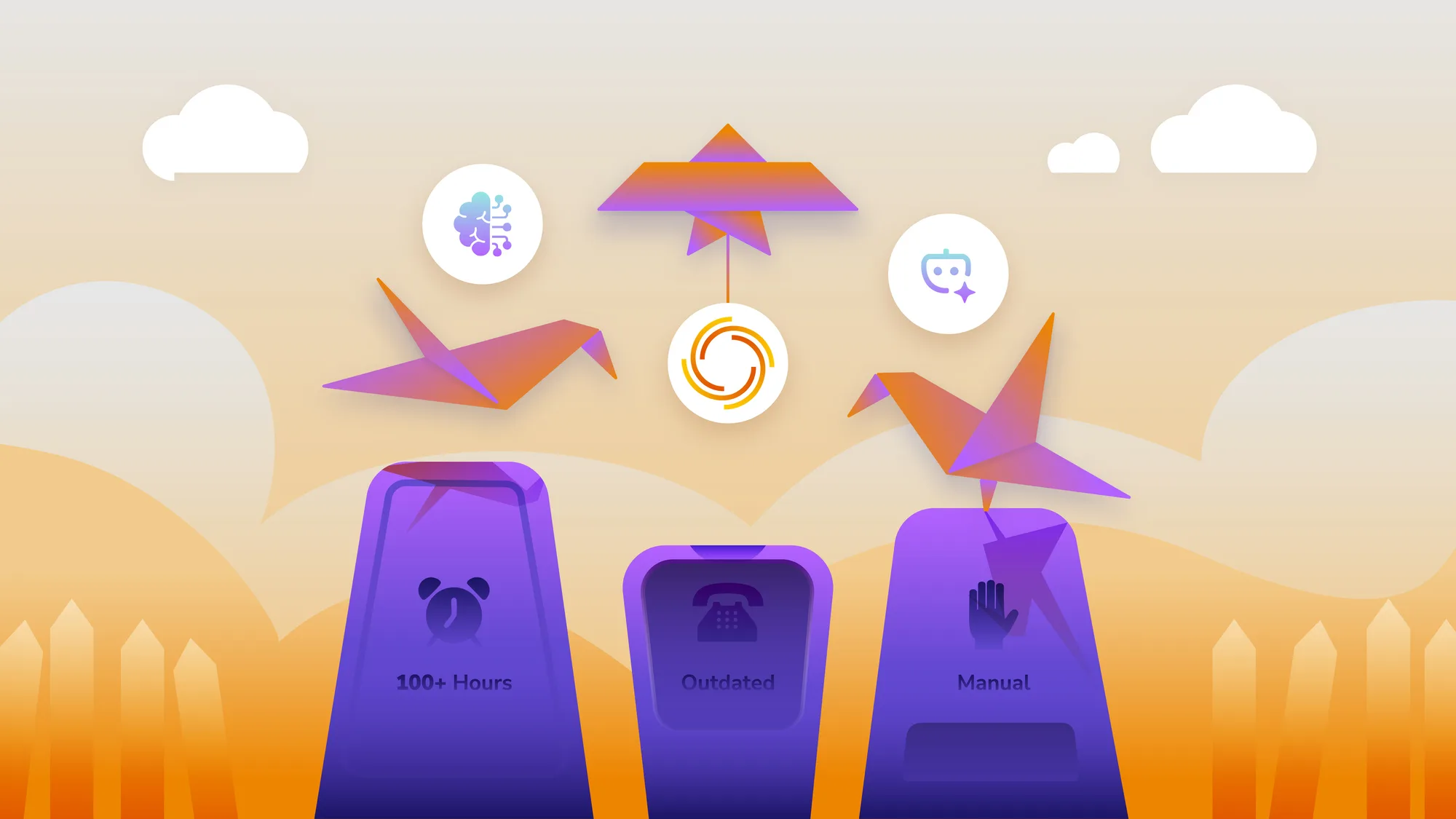
The past two years were the “AI experimentation era.” Agencies tested prompts, trialed point tools, and sped up specific tasks — but most kept the same manual, fragmented operating model underneath.
2026 is where the industry draws a hard line.
The market is shifting from AI tools to AI operating systems. Agencies that don’t rebuild will face rising CAC, shrinking margins, lost speed, and falling win rates as clients expect live intelligence, not static decks.
The agencies that win in 2026 won’t be the ones dabbling with tools; they’ll be the ones running on AI as their operating system.
This article outlines 7 agency practices that will disappear by 2026, what replaces them, and how SolaraIMPACT powers this transformation.
Death #1: Manually Written Brief
For years, briefs were treated as simple starting points. In reality, they’re operational drains.
According to Asana’s global Work Index, knowledge workers now spend 60% of their time on ‘work about work’: collecting inputs, documenting requirements, chasing missing details, and aligning stakeholders. In agencies, this burden lands directly on strategists, PMs, and creatives.
Manually written briefs are slow, inconsistent, and subjective. They depend on who writes them and what they remember. By 2026, they disappear.
What replaces them
Automated, AI-structured briefs that assemble themselves using:
- CRM and client history
- Web analytics and behavioral insights
- Audience segments and micro-intent clusters
- Brand guidelines and past campaigns
- Real-time industry and competitive data
Instead of asking teams to remember everything, systems will retrieve and structure everything.
Where SolaraIMPACT fits:
SolaraIMPACT auto-generates comprehensive briefs from integrated data sources — turning scattered inputs into structured intelligence in minutes, not hours.
Death #2: Generic Personas & Static Targeting
Traditional buyer personas built on demographics (age, gender, income, location) are rapidly losing their relevance. Recent research reveals that 60% of marketers now outdated and oversimplified marketing method.
The problem? Static personas ignore behavioral reality. Two people of the same age and city behave completely differently based on intent, context, and emotional state.
What’s replacing this outdated model?
Behavioral segmentation and real-time persona evolution.
Instead of frozen demographic profiles, modern marketers are building dynamic segments based on actual behavior — purchase intent, psychographic triggers, contextual signals, and sentiment analysis. These living segments update continuously, reflecting current motivations rather than assumed characteristics.
The future is predictive audience intelligence – systems that identify who will buy, when, and why. Static personas become obsolete. Living, predictive audience DNA will be the new norm.
Where SolaraIMPACT fits:
SolaraIMPACT’s Audience DNA Mapper transforms raw data into strategic leverage for modern agencies.
It enables real-time micro-segmentation across transactional, behavioral, psychographic, contextual, and sentiment inputs, building deep audience profiles in minutes instead of weeks.
Each segment is instantly aligned to the right messaging, channels, creative angles, and offers, while modeling direct impact on CAC, LTV, conversions, and revenue. As behavior patterns evolve, campaigns adapt in real time—keeping agencies ahead of shifting markets.
Learn more about segmentation here: How AI-Driven Behavioral Segmentation Rewrites Customer Economics
Death #3: Multi-Tool Chaos
The average marketing team now juggles 10–20 different tools across analytics, content, research, project management, competitive intelligence, and reporting.
In larger organizations, this number can multiply quickly — creating stacks so bloated they slow teams down instead of enabling them.
For agencies, this “multi-tool era” has reached a breaking point.
Every tool solves one problem — but creates three more:
- Data fragmentation: insights live in dozens of dashboards
- Cost inflation: overlapping subscriptions with minimal ROI
- Inconsistent outputs: different tools = different logic = inconsistent strategies
- No single source of truth: every team pulls data from somewhere else
The result?
Slow decisions. Conflicting insights. Expensive inefficiency.
By 2026, this model collapses under its own weight.
What replaces it?
Agencies will shift from tool collections to AI Operating Systems, like SolaraIMPACT, that
- aggregate data from multiple sources
- centralize research, strategy, content, and reporting
- maintain consistency across all outputs
- enable real-time decision-making
- eliminate the need to stitch tools together manually
Instead of dozens of tools, agencies will rely on one integrated brain.
Where SolaraIMPACT fits:
SolaraIMPACT isn’t just another tool — it’s the AI Operating System that replaces chaos. With 20+ interconnected modules, it automates the work of an entire marketing team, cutting prep time by 80% and eliminating tool-switching. Powered by live intelligence sources like Meltwater, Semrush, and Census, it delivers evidence-based insights instead of AI guesses. The result: radical speed, lower costs, consistent execution, and faster pitches with higher win rates.
Death #4: Manual Research
Manual research (digging through reports, competitor audits, benchmarks) worked until AI stepped in. McKinsey reports 57% of work activities are highly automatable, especially data-heavy, repetitive tasks like marketing analytics and research.
Manual research is no longer competitive. It’s too slow, too fragmented, too expensive. By 2026, teams spending 40–100 hours per pitch lose deals to agencies generating the same insights in under an hour.
What replaces it
Real-time intelligence engines that continuously synthesize:
- industry and category trends
- competitor movements
- audience behavioral signals
- channel and performance patterns
- contextual and sentiment shifts
Insights that once required full analyst teams now appear instantly – continuously refreshed, always current.
Where SolaraIMPACT fits
SolaraIMPACT eliminates manual research by connecting directly to premium live-data sources like Meltwater, Semrush, and Census — delivering real-time, verified intelligence in minutes. The real value isn’t just speed, but what becomes possible once research is automated, consistent, and always current.
How It Solves Research Objections
- Outdated AI outputs? SolaraIMPACT uses live APIs, grounding every insight in current market and competitor signals.
- Trust issues? Intelligence layers are cross-verified with press mentions, share of voice, SERP data, and behavioral trends.
- 40–100 hours of digging? Compressed into ~1 hour — the work of 5 people done by 1.
- Capacity bottlenecks? Agencies scale to 2–3× more clients without hiring.
- Data changes too fast? Live sources keep insights current in real time.
What This Unlocks
- Faster pitch cycles
- More accurate strategies
- Higher client trust (“data-backed, not AI-guessing”)
- Scalable research engine that never sleeps
- Consistent quality across teams
Death #5: Static Pitch Decks (built slide-by-slide)
For years, pitches were built the same way: slide by slide, insight by insight, piece by painstaking piece. Pitch cycles stretched for weeks. But AI reset expectations – clients now demand real-time intelligence and pitch-ready material in 24-48 hours.
Static decks disconnected from live data can’t keep up. By the time the deck is done, the market has shifted and the window has closed.
What replaces it
Automatically generated, intelligence-powered pitch blueprints that assemble instantly from:
- real-time insights
- validated market data
- audience segmentation
- strategic messaging
- competitor counter-arguments
- ROI and impact forecasting
- narrative structure aligned to buyer psychology
Where SolaraIMPACT fits
SolaraIMPACT’s Pitch Accelerator compresses the entire cycle —
from 40–100 hours → down to 1 hour.
One brief in →
A full, data-backed pitch out: structure, insights, storyline, messaging, differentiation, and projected impact.
Pitching stops being a bottleneck.
It becomes a competitive weapon.
Discover the 5 pillars of strategic pitching that are redefining agency success in 2026.
Death #6: Manual Campaign Planning
Campaign planning is painfully slow. Strategists spend weeks auditing data, mapping messaging, building hypotheses. Even strong teams need 100+ hours to get it right.
But markets don’t move on human timelines. Customer behavior shifts hourly. Competitors pivot overnight. Channels evolve weekly. Manual planning can’t keep pace. Campaigns launch already outdated, built on stale research and static assumptions.
What’s replacing it?
AI-driven campaign builders that assemble complete strategic frameworks automatically:
- channel mix
- budget allocation
- creative angles
- messaging grids
- segmentation logic
- testable hypotheses
- performance projections
- competitive counter-strategies.
Where SolaraIMPACT fits
SolaraIMPACT’s Campaign Builder generate 40–80 pages of structured, data-backed strategy in under an hour, powered by live market intelligence, behavioral insights, and integrated data sources.
This isn’t just faster planning. It’s the complete replacement of manual campaign architecture with systems that deliver depth, precision, and speed simultaneously.
Death #7: Reporting as “What Happened Last Month”
For years, agency reporting has been backward-looking. Teams compile dashboards, export analytics, build monthly summaries, presenting what already happened, long after anyone can do anything about it.
In 2026, that approach is a liability.
If a campaign underperforms for three weeks before anyone notices, the damage is done. Budgets wasted, opportunities missed, clients frustrated.
The market moves too fast for retrospective analysis.
Brands need to know what happens next, not what happened last month.
What’s replacing it?
- predictive, real-time performance intelligence
- forward-looking CTR and ROAS forecasts
- early warnings for creative fatigue and drop-offs
- continuous health monitoring across channels
- automated detection of behavioral shifts
- scenario planning before you commit budget
Not reporting, but anticipation.
Where SolaraIMPACT fits
SolaraIMPACT replaces post-mortem analysis with continuous modeling – segment-level predictions, revenue and CAC/LTV forecasting, automated alerts when something’s about to break.
Instead of telling clients what happened, you show them what will happen next, and how to fix it before it costs money.
The Big Idea
The agency model that dominated the past decade is now reaching its breaking point.
The market became too fast, too complex, and too data-driven for manual, fragmented, human-paced workflows to survive.
By 2026, the systems that can’t keep up will simply disappear.
What becomes the new standard
- AI-powered workflows that operate at real-time speed
- unified operating systems instead of 10–20 disconnected tools
- behavioral segmentation over demographics
- live data instead of outdated research
- predictive analytics over monthly reporting
- automated strategy engines that compress weeks into minutes
The advantage belong to the agencies that run on AI — those that treat intelligence, automation, and speed as core infrastructure, not optional add-ons.
This is exactly what SolaraIMPACT delivers today:
a unified, multi-AI Marketing Operating System designed to replace the inefficiencies that are collapsing, and empower the operational model that’s rising.
Ready to see what 2026 looks like for your agency?
Book a 30-minute Demo and discover how SolaraIMPACT transforms manual workflows into AI-powered competitive advantages.
See the platform that’s already powering the agencies winning in 2026.